
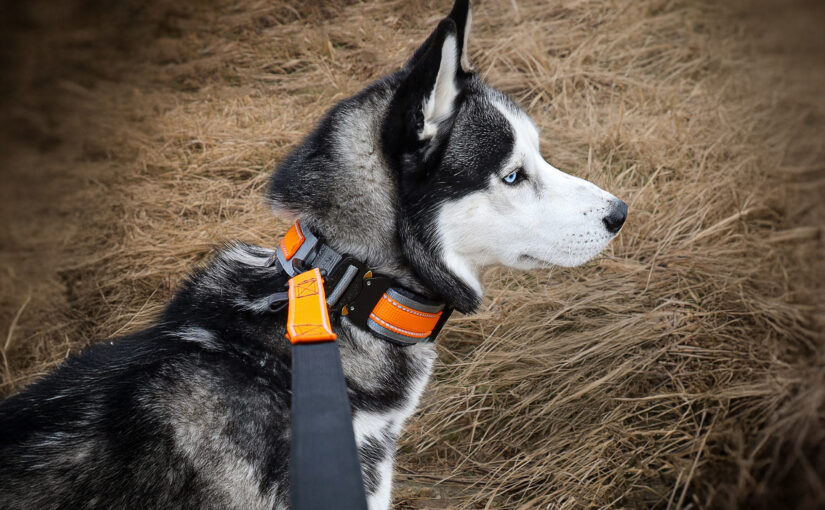
Shock-absorbing webbing, sometimes known as Ultraflex, looks like ordinary webbing at first glance. But it stretches from 100 cm to 140 cm and springs back; the force needed for that is 6 kg for the 15 mm width, 8 kg for 20 mm and 12 kg for 25 mm. That stretch absorbs the jolt, softens a sudden pull and is easier on both the handler’s hands and the dog. We sell it in widths of 15, 20 and 25 mm, with a thickness of 3.5 mm. It is a material for bungee leashes, canicross, running with your dog and everyday walks with larger dogs.
But be aware: with the stretch come new challenges. Shock-absorbing webbing behaves quite differently from standard polypropylene webbing. So let’s go through it.
How shock-absorbing webbing behaves in practice
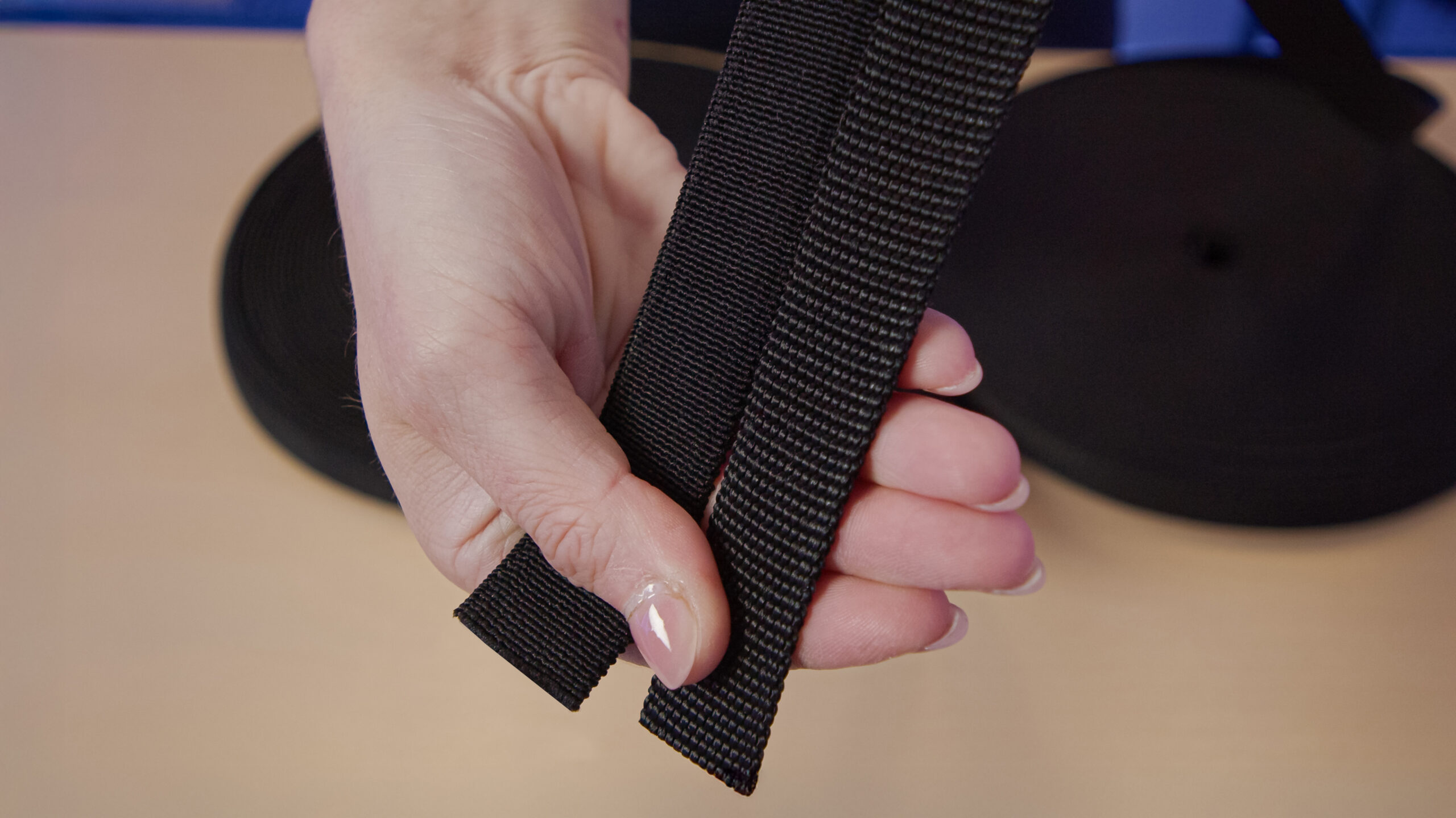
Picture two leashes. Same length, same width. One is made of PP webbing and keeps its shape and length. The other is made of shock-absorbing webbing, which stretches nicely when pulled. That stretch cushions the jolts that would otherwise go straight into your hand (or into the dog). Where standard webbing yanks your arm, elastic webbing smoothly takes up the shock.
VIDEO 1: The structure and the stretch, shown clearly.
What if I want to put rivets or holes in it?
The short, honest answer? No. It is not suitable.
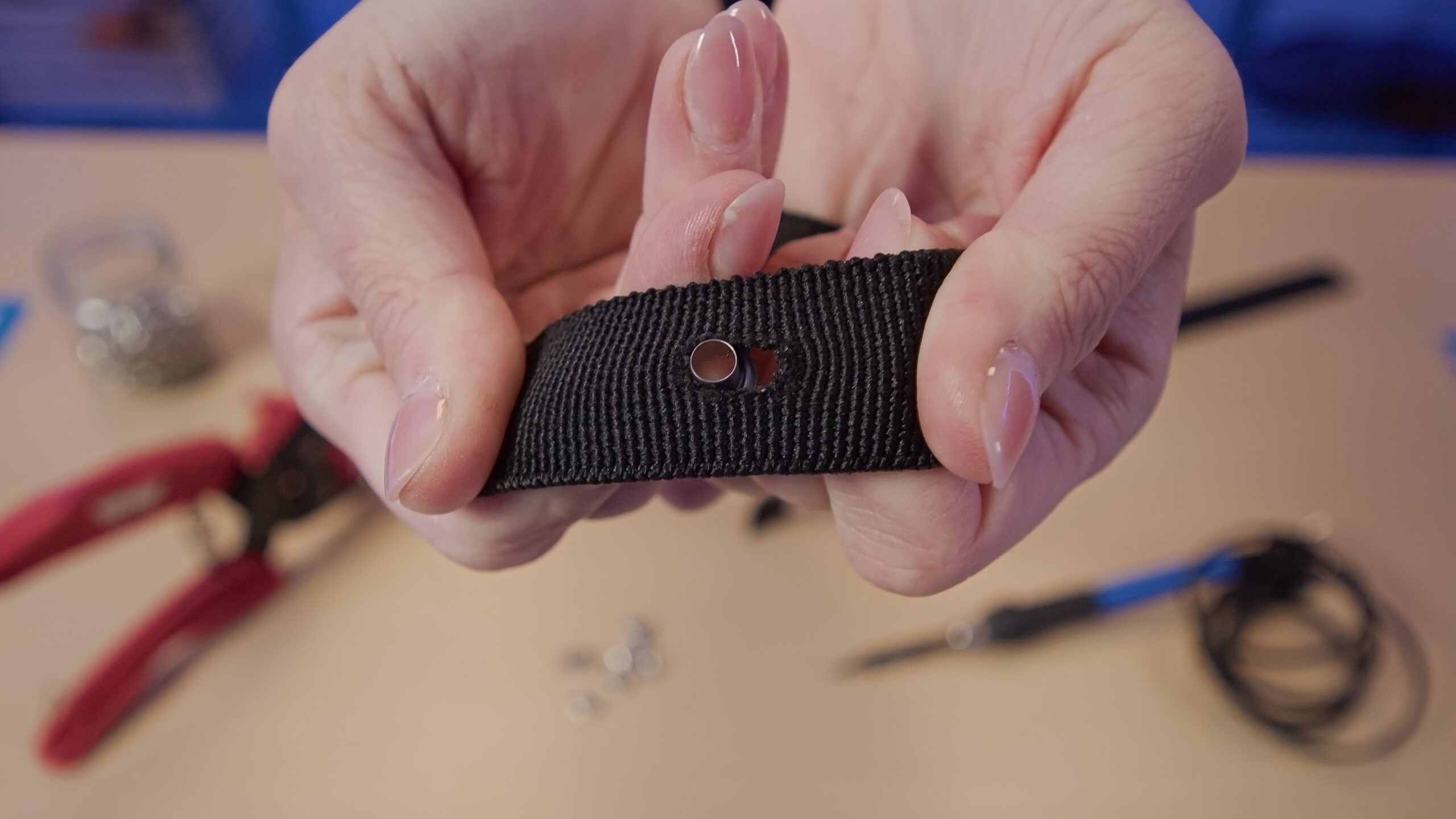
Shock-absorbing webbing is not made for punching or riveting. Because it stretches:
- holes deform under tension,
- rivets wobble and do not hold,
- grommets pop out,
- and burned holes tend to tear.
So: no holes, no rivets. If you want a joint that lasts, you need a sewing machine.
How to sew shock-absorbing webbing so it holds
Sewing takes skill, and with shock-absorbing webbing even more so. Once you know how, the joint holds.
Recommended equipment
✅ Needle: heavy-duty denim needle (size 100–110)
✅ Thread: strong polyester thread, for example Synton 40
✅ Machine: industrial (a home sewing machine can handle at most one layer of the thick shock-absorbing webbing; you can sew the thinner waterproof webbing on a home machine too)
You will find heavy sewing needles in our range.
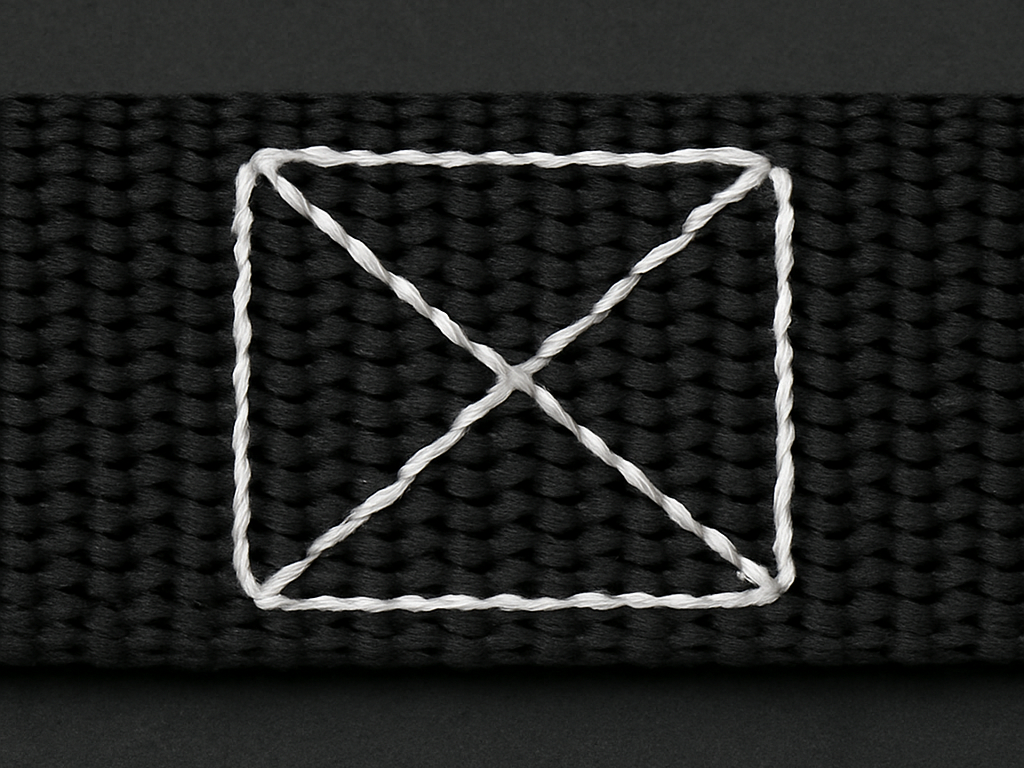
Box X stitch: a small stitch with a lot of strength
If you want the joint to really hold, use the box X stitch: sew a rectangle, then stitch both diagonals to form an X. Use it on tow straps, harnesses, collars… anywhere the joint has to withstand pulling, jerking and stretching.
It is simple, and the joint holds.
Two sewing techniques: simple vs. combined
VIDEO 2: Simple sewing: shock-absorbing webbing folded over, snap hook threaded on, two layers, box X stitch
VIDEO 3: Combined sewing: shock-absorbing webbing tucked between two layers of standard webbing, three layers, box X stitch
Here an industrial machine is a must. A home machine will struggle, and lose.
Fix the layers before sewing for accuracy
Before you start the sewing machine, it is a good idea to fix the layers together. You can use:
Double-sided tape
- thin, narrow, good quality (for example Tesa, 3M)
- do not use foam tape
- holds well, no smell, quick to work with
Contact cement (neoprene glue)
- apply the glue in 1–2 thin coats
- let it dry before joining the parts, otherwise it will gum up the needle and get on your nerves
Combining it with standard webbing
The most common combination is:
- Stretch section: shock-absorbing webbing
- Ends: standard PP webbing (for example for the handle loop or the snap hook)
This gives you a leash that stretches only where it should and still has secure attachment points.
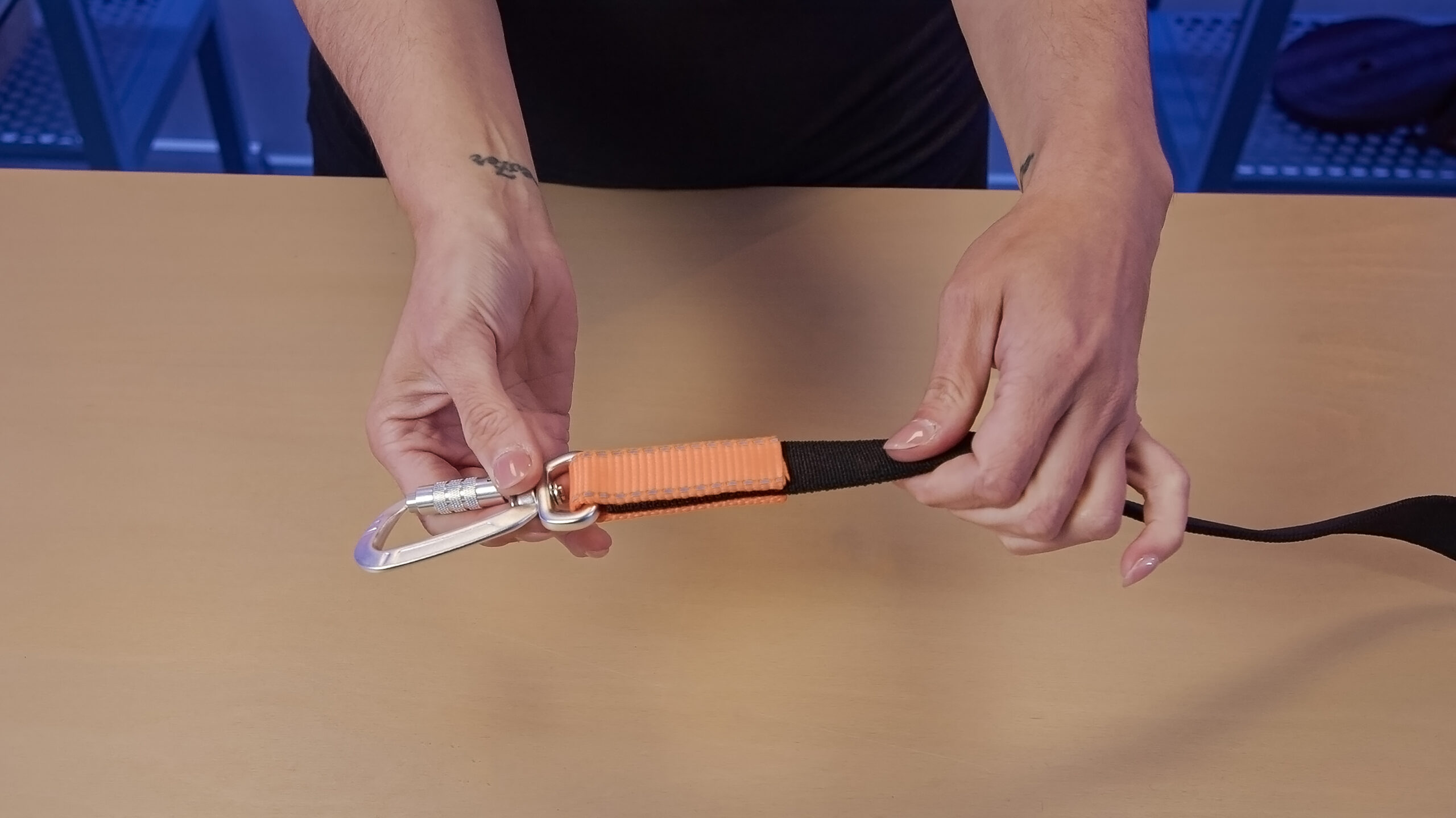
What it looks like in large-scale production
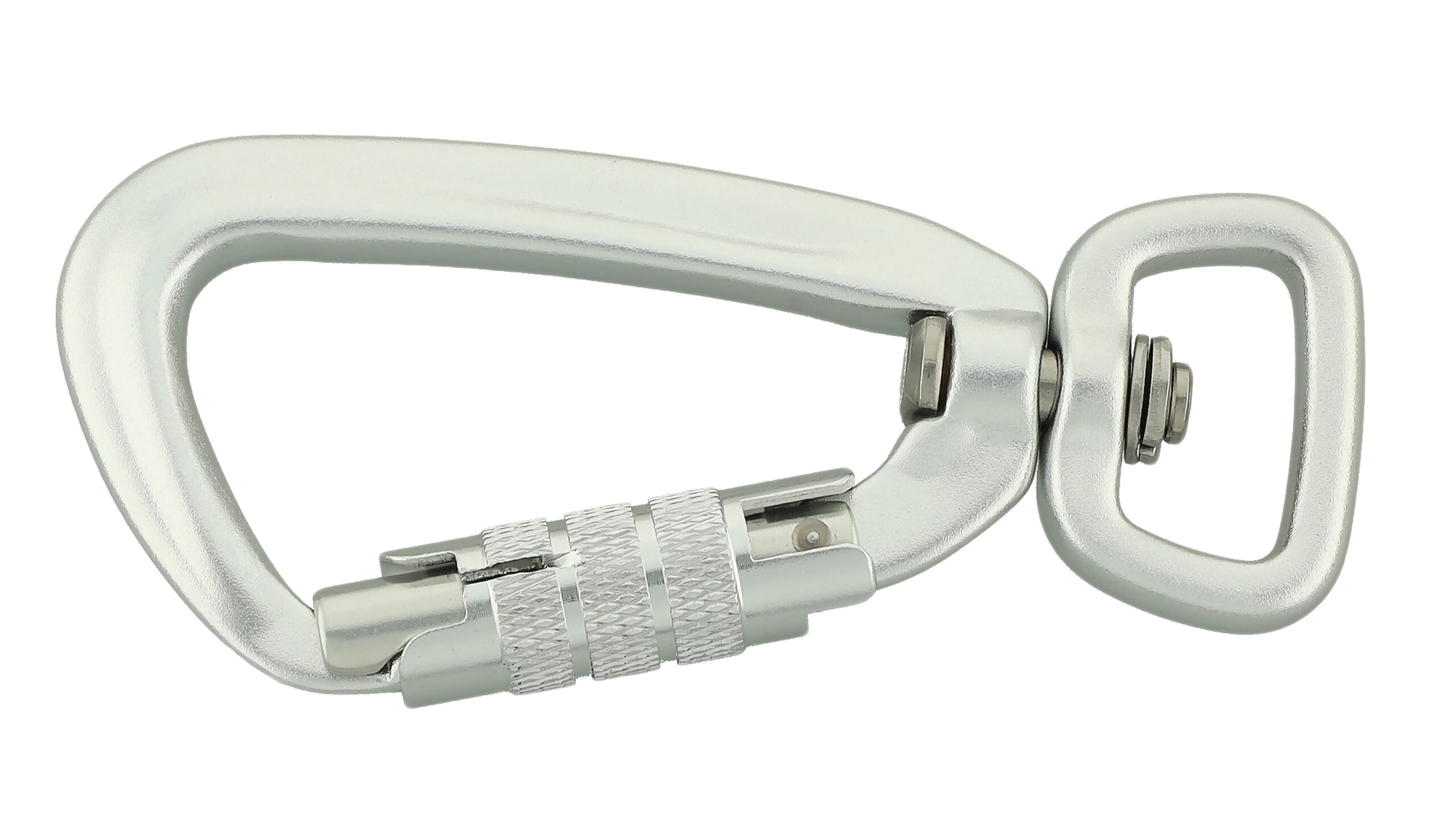
Warning: do not use plastic snap hooks
Not even for a small dog. Not even on a dare. Not even “just for a moment”.
Shock-absorbing webbing can pull hard, and a plastic snap hook is the weakest link. Use lightweight aluminum snap hooks, preferably with a locking gate.
Summary: shock-absorbing webbing in a nutshell
✅ Absorbs pulling
✅ Comfort for both dog and handler
✅ Neat look
❌ Riveting? Nope.
✔️ Sew only with a box X stitch, preferably glued first
✔️ Combined with standard webbing = stability and security
✔️ And above all: no plastic snap hooks.
Shock-absorbing webbing is not just “something stretchy”. It is a material with character that helps you make a leash that looks good, works, and can handle even a strong puller. You just have to use it right.
How a bungee leash made from shock-absorbing webbing behaves outdoors
For standard webbing without sewing, see How to Make a Dog Collar Without Sewing.
Pethardware.com
The only shop you’ll ever need for crafting collars and leashes.
Visit Pethardware.com