
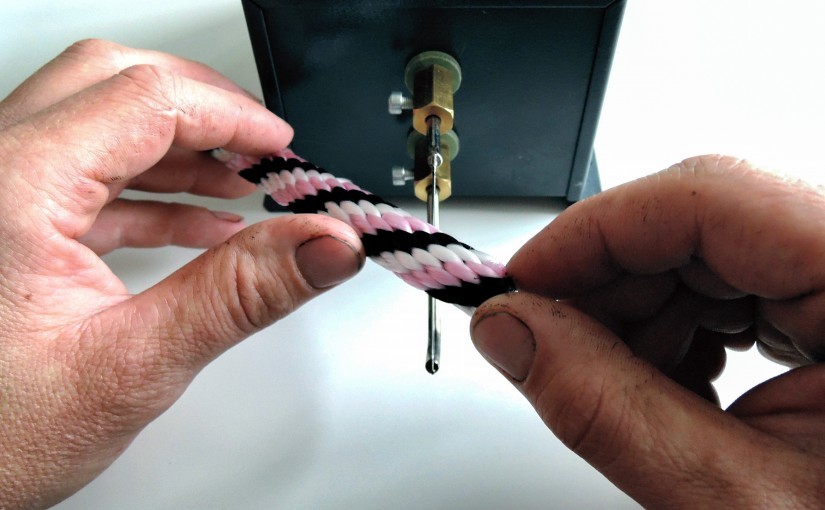
The cleanest cut comes from a stationary hot knife cutter for webbing and rope. It cuts by melting the material at the right temperature of 170 to 180 °C. Here is how to work with it.
When cutting rope and webbing, follow safe working practice so that you do not get burned by the hot blade or by melted polypropylene from the rope.
Caution: the temperature is high not only at the cut but also a few centimeters away from it.
Stationary hot knife cutter

A webbing cutter is a simple device that works on the resistance wire principle. It cuts with a thin, fixed, heated blade. The blade has a small cutting edge along its top and is long enough to cut even thick rope and wide webbing. The main advantages of a hot knife cutter are a clean, sealed edge that does not fray, an accurate and steady cutting temperature, and both hands free to guide the rope.
We do not sell hot knife cutters; look for a “hot knife webbing cutter” in shops that sell textile machinery.
The right melting temperature for cutting
Getting the blade temperature right matters a lot. Below the melting point of polypropylene, the cut takes longer or becomes impossible. You have to hold the rope against the blade for a long time and the cut ends up ragged and incomplete. If the temperature is too high, you get an unnecessarily large bead of melted material and the material at the cut degrades. The cutter is set to the right temperature and holds it constantly.

Both hands free while cutting
With a webbing cutter you have both hands free and can make an angled cut easily. There are also small handheld hot knives. Their drawback is that you have to hold them in one hand, which makes an angled cut very difficult. A handheld hot knife does, however, cut rope and webbing straight across well.
How to cut polypropylene rope: steps and rules
1. Cutting direction and angle
Cut rope for leashes and harnesses at an angle of 45 to 55° so that you can weld the tapered tip easily. Hold the rope in both hands and cut from the thicker part toward the thin end of the tip. This makes it easier to get the angle you want, and the tip will have a sharp edge that does not fray.
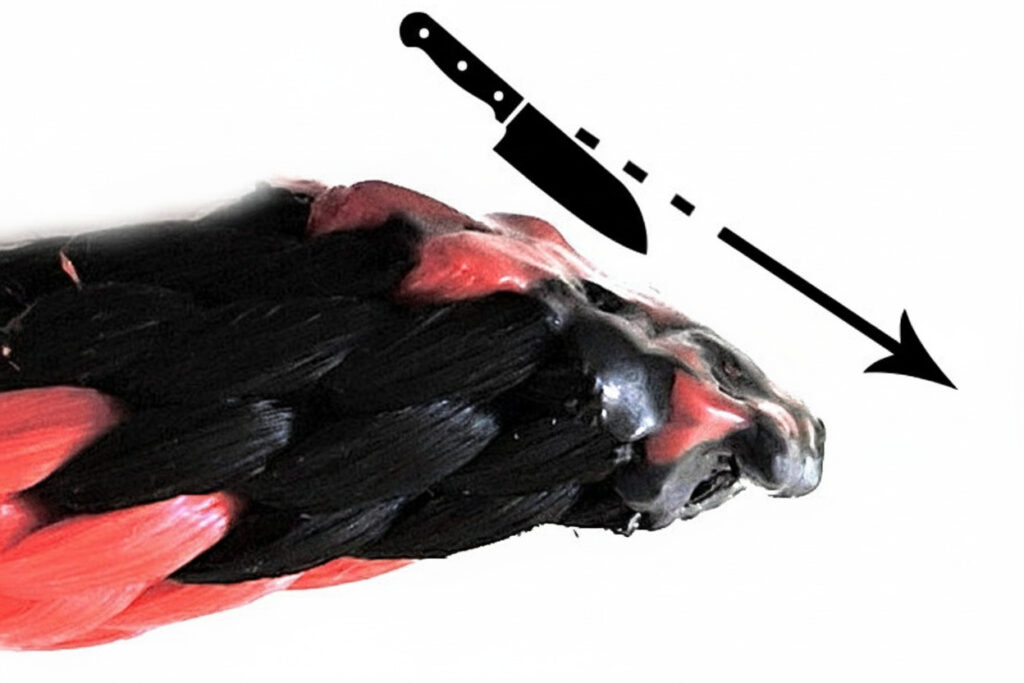
2. Cutting technique
Do not just push the rope through the resistance wire. Cut with a combination of pressure and a side-to-side sawing motion. When you get the cut right, the edge is smoothly sealed.

3. Cutting speed
The right cutting speed and the right pressure on the rope are another important factor that takes practice and experience. If you cut slowly, a lot of material melts at the cut and leaves a large bead. If you cut too fast, the tip frays.

Tip for beginners
Before cutting, you can wrap the rope with adhesive tape, which helps with cutting until you gain the necessary experience. The rope holds together better and cuts more easily. Just be careful, especially with thicker rope: if you wrap the tape very tightly, the melted material sticks to the tape and you will not be able to remove it.

Cutting rope and webbing with a hot knife cutter is fast and, once you get the hang of it, easy. A big advantage is that the cut edge is sealed by melting, so it needs no further finishing. You can then weld the cut rope with a soldering iron or a heat gun and make, for example, a rope dog leash.
Pethardware.com
The only shop you’ll ever need for crafting collars and leashes.
Visit Pethardware.com